Posts Tagged ‘Guatemala’

Yesterday driving home from the store on the only paved road right outside of town, I slowed down as I saw a family huddled together on the opposite side of the road. The older son, stood in the street to direct traffic around his parents who were kneeling down on the edge of the road. There is no curb between where the street ends and a small grassy ledge begins. I watch as the mom carefully places red, yellow and white flowers around a wooden cross. I drive along this road at least three times a day, slowing down just enough to go over the 6 different speed bumps, but I have never noticed that cross before. I instantly knew that this family cannot not notice that cross. They probably see it in their dreams and feel a lump in their throat when they walk by it. Because when you lose someone you love, you find the memory of them more present than ever.
I don’t know exactly what happened there. But I do know, someone they loved died in that spot, by the wooden cross on the side of the road. They went yesterday to decorate, to honor their life, and to invite anyone who drives by slowly enough to pause and take note— We remember their life, won’t you too?
Guatemala, like many Latin America countries celebrates Dia de Los Muertos or Dia de Los Santos on November 1st as a way to honor and remember loved ones who have died. In a blend of Mayan and Catholic traditions, Guatemalans visit the local cemetery arriving with arms full of fresh flowers to decorate the graves of loved ones. Some families gather to laugh and tell stories while kids fly kites. Traditionally the idea was that you can send a message on the kites up to the sprits of those who have died. Other families sit more somberly and pray, their heads resting against the large cement aboveground tombs.
There is such beauty in remembering, because it gives permission to grieve. For some grief is a very private thing, but in Guatemala grief is something that is shared. There is often something powerful about making it public, about letting other share in your pain and in your memories.In general, I don’t think our U.S. culture knows how to grieve or mourn together. We don’t like to talk about death. Maybe there part of evangelical Christian culture that makes us believe and give pat answers about how “he is in a better place.” But even when you have hope that you’re loved ones are in heaven, that doesn’t necessarily help those who are still grieving here on earth.
Other cultures seem to do this so much better, then we do. I remember reading about the Jewish tradition of saying Kaddish, a prayer for the dead, that was supposed to be said twice a day for an entire year after someone died. Whoever was mourning, was instructed to pray those words, not in solitary but with people, in community. I have had friends tell me one after loosing a parent or a sibling, one of the most helpful things people did was to share a memory of the person who died. The person grieving often feels so alone in their pain. When someone else shares a memory it reminds them of their loved one and it gives a little bit of life to someone is so recently gone. The person who is grieving is usually thinking about their loved one all of the time, so when someone else uses their name or shares a memory it usually makes them not feel so alone.
I remember one year where three friends, my age, all lost a parent. One to cancer, one to plan crash and one to suicide. No one in their twenties is ever prepared to have to bury a parent. I am not sure if can ever really be prepared to burry a parent. I remember sitting with one friend the day after her dad’s funeral. She said, “Sometimes what feels the hardest is everyone else’s world keeps going, but I feel like mine just ended.”
Typically in the U.S. we set-aside a day at best. Maybe we attend a funeral, send some flowers, write a sincere, sympathetic card and then that’s it. Our life and schedule move on. But what if there was a different way?
In Guatemala there is a catholic tradition called La Novena. It literally means “the ninth” or “the nine days.” Every night for nine days after someone has died, family and close friends gather in the deceased person’s home or in the street in front of their home just to be and sit. The family sets up white plastic chairs and a tarp or canopy to protect from rain and people come. They stop what is going on in their world to be with the one who feels like their world just ended. There is coffee and sweet bread and kids running around. For nine days people gather to mourn together and care for the widow or family who just lost someone.
I remember the first time I experienced a death here in Guatemala. Gerber called me and said the 4-year-old son of one of his neighbors had died in the town where he grew up. I naïvely asked, when the funeral would be and what should we bring. Gerber paused on the other line, “No, we go tonight for the valorio.” I remember looking at my watch. It was 5pm. I drove home, changed my clothes and we left for his neighbors’ house. There was a small casket in the front of the garden. Neighbors had already brought chairs and flowers. Baskets of sweet bread were making the rounds and everyone sat. There was some music and a prayer, people came and went, kids played in the doorway. But that family was not alone. Gerber said people would be there the whole night. The burial would be the next day and then La Novena would start. I sat there and glanced up at the young mom and her parents, who had just lost a son and a grandson, their eyes red and puffy from too many tears. I said a silent prayer and imagined for a split-second the fear of what it might feel like to lose a child.
After a few hours of sitting had passed, we got in the car to head home. I told Gerber, “Our countries handle death in such different ways.“ I explained how in the US a lot of people are cremated and then a funeral or memorial service may be planned for weeks or sometimes months later. Invitations get sent out, people fly in and schedules get coordinated. Part of this is our U.S. culture of busyness and planning, and perhaps having access to more advanced morgues and burial options. In Guatemala, people die and then are buried usually within 24-48hours because there are very few places to preserve or embalm the body.
In the U.S., I think we would like to compartmentalize grief. As if it’s something we can check off, follow 5 simple steps and then be done with it. But I think other cultures better embrace the fact that grief is a process, one that ebbs and flows with memories and seasons and certain times of year. And how beautiful to know that every year on November 1st is a day set-aside to remember loved ones who have died.
This morning, Angela, the woman who cleans our home, greeted me as I was about to leave for work. She drives a green pick-up truck, has more energy than I do and you would never know by looking at her that she has teenage grandkids. I asked her how her weekend was. “Fue bien bonito.” It was lovely.
She told me how every year on Dia De Los Muertos she goes to the cemetery where her son is buried. I have met some of her adult-children, but I never knew she had a son that died.
“He would have been 37 this year,” she smiles, like only a mother does, knowing exactly how many birthdays have passed.
“He died when he was 6 months old. He was born with a hole between his esophagus and stomach. He needed an operation, but I didn’t have money to pay for it.”
Her eyes look toward the tile floor. My heart drops. I am so sorry, I say. What was his name?
She smiles, Se llama José. His name was José.
When you reserve a day to honor and remember loved ones who have died, you not only acknowledged their death but you also get to say their name and remember who they were when they had life.
 For the month of October I am joining thousands of others writers and bloggers and committing to write for 31 days. I haven’t written consistently for years. I compose drafts in my head and never write them. I start posts, only to save them for later, where they accumulate in my draft box like a stack of old photos. I am well aware that some seasons of the writing life are for soaking up, gathering ideas and paying attention. But sometimes there is wisdom in just starting, in putting words on the page, fingers to the keys and practicing the discipline of showing up every day and just doing it.
If you’re new here you may not yet know how much I like questions. I like questions that challenge me, like when Andy Stanley asked, “What does Love Require of me?.” I ask a lot questions about raising a bicultural and bilingual daughter like, “Will she feel more Guatemalan? or American?” I’ve written about what I learned in my 20’s and that being able to ask good questions and listen to how someone responds are of equally importance.
For the next31 days I am going to write 31 questions that I think all cross-cultures workers should ask themselves and those they work with. If you’re reading this and thinking, what on earth is a “cross-cultural worker?” I would say it is anyone who specifically devotes part of their life working with a group of people or culture different from the one they most closely identify with. That encompass expats, missionaries, non-profit leaders who live internationally, and locally. But I would also like to extend the definition to include educators, pastors, nurses, administrators, business owners and really anyone who has consistent interaction with people from a culture different from their own. Be it at the gym, in the classroom, around the board room, or in the living room. For me, the majority of my cross-cultural learning has taken place in Guatemala. And as a result, the majority of my writing will stem from my experience as a cross-cultural worker here, but I will also draw on experiences and questions from being a teacher, a wife and mom.
My hope is that the questions I will ask and discuss will apply across generational, socioeconomic and ethnic lines. My hope is that teachers, working with students from a minority (or majority) culture can also relate. And that youth pastors working with teenagers who are almost an entirely different culture altogether will also be able to relate. I hope that parents trying to connect to their kids, will be able to relate. I even think many of the questions also apply to marriages, because even when both spouses come from the same “culture” we all know that people have very unique family cultures.
Questions have the potential to help us get to know someone else better by first helping us know ourselves.
So, join me for the next 31 days to find out what are the 31 questions worth asking.
You can check back to this page and I will list the questions by day. Or you can sign-up on my blog under the “email option” in the righthand column so you get an email delivered to your inbox with each new post.
Look forward to writing and discussing this with all of you.
Here’s to 31 days,
Michelle
Check back here for links to each day:
Day 1: Do you use person first language?
Dat 2: How do you define poverty?
Day 3:
This one has been in my draft box for-ever. In fact, I would be embarrassed if you knew how many half-started blog posts are sitting in my draft box right now. (ahem. maybe close to a 100). I figured maybe part of my goal for the year should be to publish some of this half-finished thoughts, eh?
I digress. So I guess technically this is my first video blog, which people call a vlog. But I just can’t make that into a word, so I will go with video blog for our purposes.
If you know me or have seen any pictures of me and my daughter from the past year, you already know that she has spent a large portion of her life in my arms. I mean I carried her home from the hospital in this sling and still to this day, we use our Guatemalan Carrier/Wrap/Sling every night. (In Spanish it’s called a cargador, which loosely translated to carrier, I guess).
Most indigenous Guatemala women can do all kinds of fancy throw-your-baby on your back and on your hip kind of holds. I am just showing you the basic, tie-a-knot-make-a-sling-kind-of-hold. My favorite part is, you can use ANYTHING. We used an old gray sheet for a while. I still laugh sometimes when I think about how baby-wearing has become a “thing” in the US, because I am pretty sure in Guatemala and probably around the world, mamas have been wearing their babies for centuries without buying a single thing.
Ok, without further adieu here is the video:
P.S.S. Wanna see some of my Guatemalan friends show how they carry their babies? Check out this vidoe or this one to see the experts! Enjoy.
I am so excited to be guest posting today over at Rachel Pieh Jones’ blog. I kind of think of Rachel as an expert in cross-cultural living, mothering & writing as an expat living in Djibouti. And if we’re ever in the same country I would jump on the chance to grab coffee with her just to listen and learn from her. I think you’ll find her perspective refreshing, honest and challenging.
A while ago she invited readers who to share what they observed while strolling through their town. It’s been a fascinating series with women writing about life in Cambodia, Tanzania, Russia, Ireland and about every other country in between!
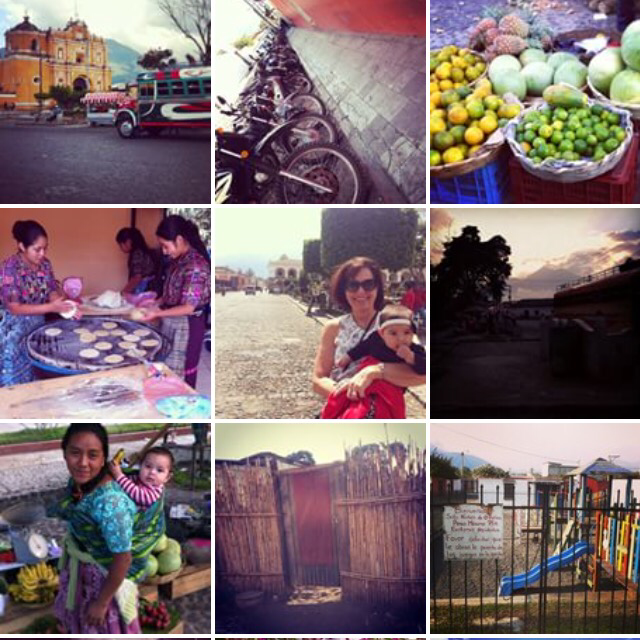
So I wrote about life in Guatemala. Some of you know last year I did a little project of my own to appreciate and take note of my town. You can follow along on instragram with the hashtag #mytownGuatemala to get a glimpse.
Here’s my piece from Rachel’s blog:
. . .
Most afternoons before the sun starts to fade I put my daughter in our oversized stroller and push her up the hill from our house. We walk through two metal gates to get to the street. She waves at the white dog that always sits by the corner looking for scraps of food. We pass a woman balancing a basket on her head. She greets us, “Buenas Tardes” and then pauses to smile at my daughter. Babies are universal conversation starters. She asks, how old she is and then comments, “Esta bien grande” I smile, knowing from personal experience, that to be called “big” is a compliment. In my head I have learned to translate “big” into “tall.”
To read the rest click here:
. . .
Also, if you’re looking for some more of Rachel’s work, these are a few of my favorite essays and posts of hers | This piece from the NY Times Modern Love Column | The Proper Weight of Fear | Rethinking the Christmas Story | I Don’t Promise To Keep My Kids Safe
On Monday night we boarded a redeye flight from California to Guatemala. We’ve done this numerous times before, the difference being this time the little baby we thought would sleep was wide awake. We sat on the runway for a while before being giving the clear to take off. As she stared out the window pointing at the lights, we tried our best to keep her occupied. Like any parent who has flown with a toddler knows, you’ll do anything to keep them quiet and contained. I started whispering “bye bye” to each item we spotted out the window. We waved bye bye to the moon and to the lights and to the man with the orange flashlight. We continued…
Good-bye to Nana, Good-bye to Papa, Good-bye to Bean and wooff wooff,
In her sweetest voice she repeated, “byyeee, byeee.”
Good-bye Bobo and Grandma Charlotte. Good-bye Tia Steph and Uncle Brian.
As the plane started to speed up we waved good-bye to Target and Trader Joe’s, REI and easy returns. We waved goodbye to Starbucks and the sleeping deer. Good-bye library and the parks with no sand.
Good-bye 5-lane freeways and the carpool lane. Goodbye sushi and roasted seaweed.
Good-bye beach walks and friends in Santa Barbara. Good-bye Boat House and Blenders.
Good-bye Jen, Good-bye June. Good-bye church and cousins in LA. And good-bye putting toilet paper in the toilet.
As the headed west out over the Pacific and the lights behind us faded we waved one more time. I whispered in her ear…
Good-bye California.
. . .
I looked out the window into the black sky. I swallowed the ache in my heart. So much has changed since I first left.
I moved to Guatemala trusting that still small voice that says, Go, Will you trust me? My plan was for a year. I think if someone had told me you’re leaving and not coming back, I probably wouldn’t have gone. But a year seamed do-able, even desirable. And in these 4 years some pretty significant life changes happened: I fell in love and got married. We bought a home and then welcomed the birth of our daughter. My life has expanded and changed and simplified in a million ways. I became a foreigner, a wife and a mother within a span of three years. Sometimes when I let that all sink in, I think, woah! That’s a lot.
And then we go back for visits like this past one. And I soak.it.all.up.
My parents spoil us. They do everything possible to make visiting with a toddler easy. They let us borrow a car and give us the guest bedroom, they buy diapers and wipes and set-up a changing station in our room. They have a closet full of toys for Elena to play with and a fridge full of food for us. They welcome us and love us well.
One of my very favorite things was watching Elena reach her arms out for Nana or Papa. My sister spoiled her with crafts and cups of Starbucks’ hot chocolate and she spoiled us with free babysitting for date nights and afternoon errands. Gerber and I went to the movies together for the FIRST time since Elena was born. We saw, the Hobbit (his choice) and Interstellar (my choice).
I have a new appreciation for the benefits of living close to my family. I get a glimpse of what it could look like.
Then we went to Santa Barbara for a week. Some of my favorite people and favorite places are there. We bounced around and stayed with three different friends’ who gracioulsy hosted us. We piled Elena in the car for dinners with friends and breakfast dates. We walked along the beach and spent a morning out on the pier at the Sea Center Museum. I planned play dates and we had an open house. I visited the high school where I taught and ran into a few old students around town. The week was full. On our way out of town we even stopped for coffee with two of my favorite professors.
We drove down the 101 with the ocean sparkling in the rear-view mirror. As, we rounded the last curve the orange-pink sunset slipped behind the hill and I sighed. Not a sad sigh, just a nostalgic, heart full and heavy sigh.
Maybe I was mourning what I left behind. Or maybe just reminiscing. Although we all know the past often looks better when seen through rear-view mirror sunsets. I know in a heartbeat I would leave it all again, but for some reason being back this time touched something different.
. . .
Elena finally settled down on my lap, buried her head in my chest and was asleep before they turned off the cabin lights. I leaned my head back against my seat and closed my eyes. Gerber grabbed my hand. He knew. He always knows. Even when we don’t exchange words, he senses the heaviness in my heart. He saw the tears as we waved good-bye to my family at the airport.
I glanced down at my husband’s hand tightly wrapped around mine and the little girl asleep in my arms. I may have left some really good things behind, but I am deeply thankful for what I gained.
A few short hours later, the captain makes an announcement in Spanish that I am not awake enough to understand. I lift open the window shade and let the light in. Elena pops open her eyes and pulls herself up to peer out the window.
Down below is Guatemala, in all of her majesty. Volcanoes, lakes, tiny cement pueblos built on the edges of cliffs.
We start the slow descent by waving hello to everything she knows in Guatemala.
She waves hello to horsies and doggies in the street. Hello, to agua and the fountain in Antigua.
Hello, Mama Hilla and Papa Choyo. Hello, Tia Mimi & Tia Ara. Hello, Sofi and Emmita.
Hello, Guayo and Dalilia. Hello, Alessandra and Tio Walter.
Hello, nuestra casa and the community playground. Hello, bumpy streets and breakfast bagel dates.
Hello, black beans and handmade tortillas.
Hello, Guatemala.
We are home. My heart is full and yet there is always an ache in the leaving, huh?
I was talking to my Gerber on the phone tonight because he’s gone working for the week with a team from Canada. He asked, “Are you excited about your birthday?”
I am, I replied.
I could hear him smiling through the phone.
I know he loves me dearly, be he doesn’t totally understand why birthdays are a big deal to me. And that’s ok. If I have learned anything in my marriage, it’s not about convincing the other person to be like you, it’s about accepting the other person as they are. And he accepts me. Birthday hoopla and all.
I will be 32 tomorrow. And although I love kind words and little gifts and free things, the truth is I like those things any day of the year. But what makes a birthday significant for me is that it’s a marker. A reference point if you will. I can clearly think back and remember where I was or what season of life I was in for each birthday.
5 years ago I was in Santa Barbara. I sat at one of my favorite restaurants and shared a hamburger and beer with two of my best friends. I cried tears of disappointment. Instead of pretending everything was fine, I learned that maybe that was an ok place to be.
4 years ago I wrote a vague blog post about surprises and someone special. I had moved to Guatemala and we were newly dating. He surprised me with chocolate and white twinkle lights and dinner out and then, FIREWORKS. Like real live fireworks.
3 years ago we were engaged and trying to plan a wedding and a honeymoon and get birth certificates notarized and somewhere in the mix I got sick. I spent my birthday curled up on the couch with a fever. Gerber refilled my water bottle and rubbed my feet.
2 years ago I turned 30 and I wrote about What I learned in my 20s. I remember this birthday well because it was also the day I found out we were pregnant. I celebrated my birthday and the new little life inside of me. I carried around our little secret for almost 3 months before we told people my family at Christmas time.
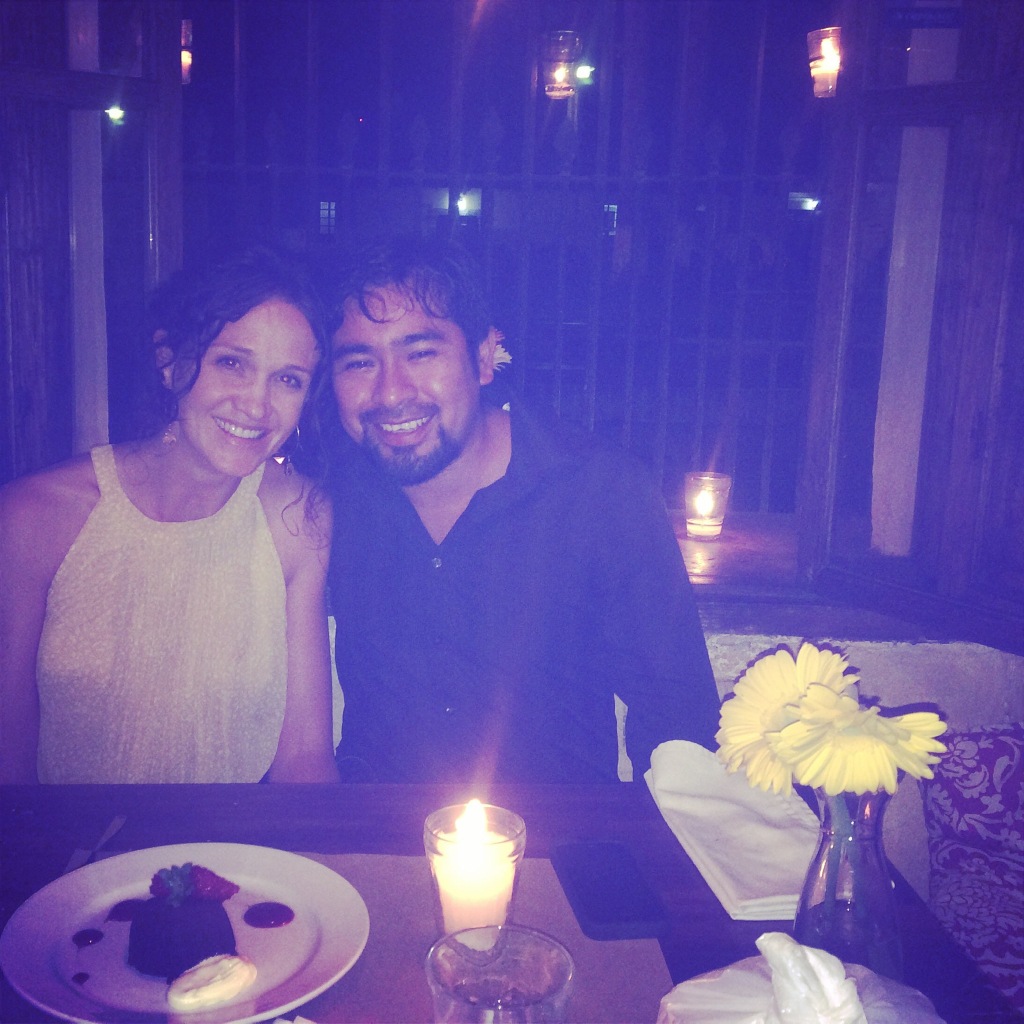
Last year at this time, we had a 4 month old who would only sleep while being carried. I wrote this post and remember that I carried her in the ergo alllll the time. Those were rough months. Gerber bought me an hour message at my favorite salon. He dropped me off and then drove around town for an hour with Elena in the carseat, trying to get her to nap with a bottle and the vibration of the car. He picked me up and we went to Hector’s for dinner with Elena. I bounced her in the ergo throughout the whole dinner and we took this picture. We look like tired, happy new parents. Which we were.
And then this year, 2014. The house is quiet, except for the buzzing of the baby monitor. Elena is sleeping upstairs, by herself. I have a cup of tea at my side and my flannel wrapped around me because the cement walls always make me feel cold at night. Tomorrow is my birthday. And in many ways it’s an ordinary day. I am going to breakfast with a sweet friend and I’m looking forward to sweet messages and texts from family and dear ones far away. They’ll be emails to respond to, diapers to change and probably a stop by the grocery store. Gerber will call in the evening. And I’ll be one year older.
And you know what? I couldn’t be more excited. Or maybe thankful is the better word. There is something about getting older or maybe it’s watching a little one grow and change that makes me thankful. Thankful in new ways for life, for health and for another year.
I think getting older makes you realize just how fragile and precious life is. One thing I love about Guatemalans, is that most people inherently view life a gift, not as a right. Sadly, when you live in a country with increased violence and lack of adequate medical care, it means everyone knows someone who has lost their life too soon. If you ever have the chance to hear a Guatemalan pray, almost always before they get to the amen, they will give “gracias a Dios por darnos otra dia aca.”
I like that. I am not sure often I have actually thanked God for giving me another day of life.
But on my 32nd birthday. It seems appropriate. I am grateful for life. For mine, and for my family’s and for my sweet little girl’s and husband’s my and good friends’. These lives make my life richer. And that is worth celebrating.
I posted this picture on Instagram this morning. Sometimes on our morning walks, as the soft light breaks through the trees, I try to imagine our town through MY daughters eyes.
I try to imagine, what does she see?
Lots of doggies roaming the streets, doggies without collars or leashes, or owners • puddles of rain water from yesterday’s downpour • los ninos walking hand in hand with their moms, bundled up with hats and jackets por el frio • loud motorcycles buzzing by usually with at least three people holding on tightly • the subtle smell of bus exhaust • the gas truck blaring “zeta gaaaas” • women balencing large buckets balenced on their heads walking toward the pila • the señora selling pan from her canasta • the man hanging off the back of the bus yelling, “tigua-tigua” in his sing-songy voice • Tall cement store fronts and cornstalk walls • the blue tigo sign • the brightly colored flowers • the big orange cathedral •
These are the things that my daughter will grow up seeing as normal. This town will be, her normal. This is sometimes still a new idea for me.
What’s foreign to me, will be normal to her.
P.S. This is part of my own little take on a yearly series called Project 52: My Town. You can read some of the other posts here.
If your new here, these are series of letters I started writing to my daughter before she was born. This was the first one, and this is one her Daddy wrote her. I wrote about her birth story here and I seem to write a lot about raising a bilingual and bicultural daughter and hardest part of motherhoods . These are my way to capture and remember parts of her life and I invite you to read along. This may be last “Dear Mija” letter for awhile, but I am sure I’ll come back to it.
Dear Mija-
In June we celebrated your first birthday. (And our first year has parents! Let’s be honest, both are equally important.)
Elena, you say “Dada” first thing every morning, you are starting to give real besitos and you would eat black beans by the spoonful if we let you. I am convinced the Guatemalan side of you will always prefer to sleep right between me and Daddy and it’s a good thing we live in a country where no one bats an eye if you breastfeed your walkin’, talkin’, toddler because that very well may be us. Your favorite things are doggies, agua and signing “more.” Maybe in that order.
Anytime you see a doggie you make the cutest little “ruff ruff” sound. Oddly in Guatemala, the toilet paper brand Scott has a cute golden retriever as its logo. So you often walk down the supermarket aisle pointing and barking.
Before you said “mama” or “dada” you said “agua.” And it’s still your favorite thing. Washing your hands, taking a shower, playing in the pool…as long as there is water involved you’re a happy camper. We’ve started teaching you signs for “more” and “all-done” around 7 or 8 months and I was convinced that you could care less. And then one day around 11 months or so you ago you just got it! It’s like it clicked and you started signing “more” ALL. THE. TIME. More agua. More beans. More nena. More books. More, more, more.
When I tell you it’s time to go “night night” you grab your monkey or your nena and start to pat their back and say “shhhh.” It’s pretty much the cutest thing ever. You now sleep in a small corner of your room on the floor, surrounded by pillows and blankets. We call it your nest, and ironically you sleep better now then you ever did in your crib.
You wave to people we see on the street and you love playing with and poking other kids. We’re working on more of the former and less of the latter. You have always liked noise and activity and being out and about. When we go to a birthday party or out with friends you’re as content as can be. But the moment I get you in the car you start to fuss and cry and basically melt down. When you meet someone new you usually give them a stare down at first. When someone talks to you, you listen with your eyes. Serious, focused and intent. When you trust someone you usually grab their hand and a cautious smile comes across your face.
Without intentionally planning it we got to celebrate your first birthday in both countries. First in California with your US family and then a few weeks later with your Guatemalan family. At Nana and Papa’s house your Auntie Christine and Stephanie decorated with an etsy banner that matched the circus theme.
Nana bought Animal Crackers and delicious cupcakes and everything was red, white and yellow. We ate grilled cheese sandwiches on sourdough bread with onions and veggies and drank fancy drinks through pretty straws.
You sat on the floor in your red birthday dress and loved trying frosting for the first time. You opened gifts and tore paper and played with the envelopes while I read your birthday cards.
You are so loved by your family in the states. Your Uncle Andrew was there and Grandma Charlotte came by. I so badly want you to have memories in that home where I grew up. I look forward to the day when you say, “I want go to Nana and Papa’s house.”
In Guatemala a few weeks later, I picked up some balloons and a “Feliz Cumpleanos” banner at the Bodegona. I had you dressed in jeans and little blouse, but when we got to Mama Hiya’s house she surprised us with a huipil and corte that she made just for you. Your Aunt Mimi got you dressed and everyone said how beautiful you looked.
You didn’t look so sure about your new wardrobe, but you were a good sport. Your abuela made pepian for the whole family and we drank rosa de jaimca.
We had a huge Winnie the Pooh piñata, which I think your cousins were more excited about than you were. We sang to you and ate cake and drank Pepsi.
I made your “cake” with banana bread and cocoa date frosting and gave you water. Sorry, Mija…if I can hold off giving you soda for a little bit longer I will.
And you are so loved by your family in Guatemala.
I love watching you grab your cousins’ hands and walk around the home where your Daddy grew up. I look forward to you learning things about your Guatemalan heritage, things that I can’t teach you.
Elena, as you get older we’ll probably have our own birthday celebrations here at home. And I have a feeling we’ll take some traditions from both families. I imagine you may always want a piñata and ya know, the Bodegona has some half-decent decorations on the 2nd level. Your Daddy and I may get you a gift or two and let you choose a new birthday outfit. I will probably make some half-healthy snacks and I think pretty straws are sometimes fun. I imagine as you grow up we will keep finding ways to honor and celebrate you, and where you come from and who you are.
Elena, each year on your birthday I want you to remember three words:
strong, kind and grateful.
These are three words I hope to teach you and model for you. Three words that I pray over you and the one day you’ll look back and say, my mama taught me how to be strong, kind and grateful.
I want you to be strong in who you are. I want you to have an inner strength to know where you come from and how deeply loved you are. I pray that your strength comes not from what you do or what you achieve but from a deep trust in God. My hope is that your strength allows you take risks, and be the kind of girl who who stands up for what you know is right and is willing to sometimes do the hard thing.
I also want you to be kind. This is something that I have had to learn how to be. Sometimes I think being a first-born means we learn to be bossy and brave, but kindness gets buried underneath being in charge. Elena, my sweet girl I want you to be kind to people, kind to the boy or girl at school who other kids make fun and kind to the old lady you see in the park. Kindness is kind of like of a muscle, the more you use if the stronger it becomes.
Lastly, and maybe more most importantly, I want you to be grateful. I want you to be grateful when we sit on plastic stools and are served caldo de galina, even if it’s not your favorite. I want you to be grateful for the home we have and the privileges that will have. I think you can either choose to live life complaining about little things, or being grateful for the big things. I hope we can always choose the latter.
Elena, I know if I want you to be a strong, kind and grateful girl, then I need to model that. So on your birthday, this is also a reminder to myself, too. Because the truth is I want to be a strong, kind and grateful mother.
Whenever Daddy asks you, “Cuantos anos, Elena?” you hold up your little pointer finger ever so proudly. Uno!
Yes, my dear you’re one. And sometimes I want to bottle up your little finger, and chubby legs and sweet smile and say, stay my one-year-old baby forever. But then I remember what a gift it is to watch you grow and change and learn. And how being your mom is one of my favorite things ever. So here’s to a lifetime of celebrating your birthday…and making me a mom.
I love you, Elena.
All my love,
Mama
P.S. Here’s a little quick 15-second look at the past 12 months, month-by-month!
Most evenings before heading up to bed, I start a load of laundry.
The water fills the basin; I toss in half a cup of liquid soap.
I dump in the pile of dirty clothes and washcloths and towels that sit in the basket. Why are there always so many dirty washcloths?
I close the lid, turn off the light and walk up the stairs, careful not to trip on the one uneven stairs at the top.
At least while I am sleeping one thing will get done.
But I can’t help but feel a twinge of tension. The tension that comes from knowing privilege.
Knowing Privilege
It’s the privilege that allows a machine to do my laundry while I sleep.
It’s the same privilege that allows me to turn on the faucet any time of day knowing very well that water will come out, when many in my community fill up buckets because for them water is not a guarantee.
Or the privilege that comes from living with the physical and emotional security of a door with a lock. I have never lived in a place without both of those.
In most countries, at least the one where I am from and the one where I live, the color of my skin gives me immediate privilege. I know because my husband’s skin color does not afford him the same. We have both felt it.
It would be silly for me to deny the privilege that I have.
Privilege that means I am not forced to choose between buying food for my family or buying medicine. I can have both without so much as a second thought. Can you imagine the heartache a young mother or father must feel when forced to chose? I cannot.
Privilege that means when it rains, it’s an inconvenience for me at best. I may get wet or an outdoor party may get canceled. But my crops or livelihood have never been dependent on the weather. Never.
Maybe the danger of living a life of privilege is how quickly it can disconnect us from the people and the places where we live.
The longer I live outside of the US, the more this tension grows. I don’t think it means we’re supposed to live in guilt and pity. That never helped anyone. However, I don’t think living in denial or ignorance is the answer, either. As with most good things in life there is something about living in between. Or better yet maybe learning to live with the tension.
A Suspension Bridge
I don’t know about you, but living with tensions sounds, quite frankly, horrible and hard.
The only kind of tension that I know is good is the kind that holds up a suspension bridge.
A bridge needs tension to remain suspended. And I often wonder if we need a healthy dose of tension in our life to remain upright. Tension that reminds us that we are in fact connected to each other and the resources in the earth. A tension that pulls on our hearts and minds because maybe that’s how God gets our attention.
What if like a suspension bridge, we were meant to live with tension?
Maybe I need to be reminded of the women walking home from working 10 hours at the coffee plantation behind my house. Maybe I need to feel a tension as I watch her two kids following close behind, carrying wood they just collected on their back. Maybe this should always tug at my heart, especially when I am driving my daughter across town for a pool play date at the loveliest spot in Antigua.
I feel this tension when I hop in my air conditioned car and leave our sweet friends in Coyolate. I drive back to the comfort of my two-story home with a bathtub and they stay in their single room home with a dirt floor and corn stalk walls.
I feel this tension when I buy my iced latte, which I thoroughly enjoy for 12 minutes while pushing Elena in the park. But I know what I just spent on my latte is what a farmer in Santa Maria will make for the whole day, on a good day.
It doesn’t mean I drive around feeling guilty, but it does mean I walk around with a tension. And it’s a tension I am learning to live with. And I think the challenge is not to let this tension paralyze you or fill you will pity, but instead move you to action and awareness.
Maybe my examples are extreme. In the US, you don’t have to feel the tension if you don’t want. Here, I find there is no way to escape it. The discrepancy of privilege and class and gender and race are plain as day here. To me the harder of the two was living in the US, because you don’t have to see the inequality or feel the tension if you don’t want to. It’s fairly easy live within the shelter of our self-contained vehicles, where you can avoid certain parts of town or certain groups of people all together.
Richard Buckminster Fuller, an American architect, inventor, and philosopher from the 1800s said, “Tension is the great integrity.” He was talking about architectural design, but perhaps the same holds true for life.
When we pray before a meal, I have started thanking God for the hands that planted the food and those that picked it. Because in many ways I know my life is deeply connected to theirs. I am not naïve. I don’t think a simple prayer or acknowledgement changes some of the deep injustices in the world. But I think it’s a place to start.
Even just paying attention does wonders on the human heart. At least it has for me. Sinking into guilt is too easy, but what if there was another option? What is it that gets your attention? What is that you notice? Is it the men who pick up your trash? Or the young guy who mows your lawn? Is it the kids that walk home from school by themselves? Or single mom that waits at the bus station after dark? Maybe it’s the farmers that work in the hot sun and don’t have access to a drinking fountain? Or sunscreen?
What is that you notice in your town? Pay attention to that. Because what I have found is that choosing to identify with one person, or one cause, is a thousand times better than feeing overwhelmed by all of the causes.
I Will Keep Doing Laundry at Night
When I close the laundry lid at night I often think about what a luxury it is that a machine will wash our clothes. I am grateful for the convenience, for the ease and for the fact that it allows me the privilege to take Elena for a walk or catch up on emails, because I am not spending hours bent over a pila hand washing our clothes.
I know most Guatemalan women or young girls spend their morning at the town pila. I sometimes wonder if some of them too might want a washing machine to wash their clothes at night. Wouldn’t it be nice? I think…if everyone had a washing machine?
But then other times, I realize that I bet some of them may actually feel sorry for me. Sorry that I live in a home far away from my mom and grandma and sisters and brothers. How lonely to do laundry at night, by yourself. Maybe I am the one missing out? Imagine how different your life or your friendships would be if you spent a hour or two each day washing, scrubbing, talking, together. I don’t really have that.
And yet again, I am reminded of the tension. I may have a washing machine, but maybe I lack something deeper.
Like all things in life, by the very nature of gaining something, you have to lose something as well.
There is a tension.
And my prayer is that I can find a small piece of integrity there.
If you’re new here I have been writing letters to my daughter each month titled, Dear Mija. It all started with this letter I wrote over a year ago on Spanglish Baby’s site.
Dear Mija,
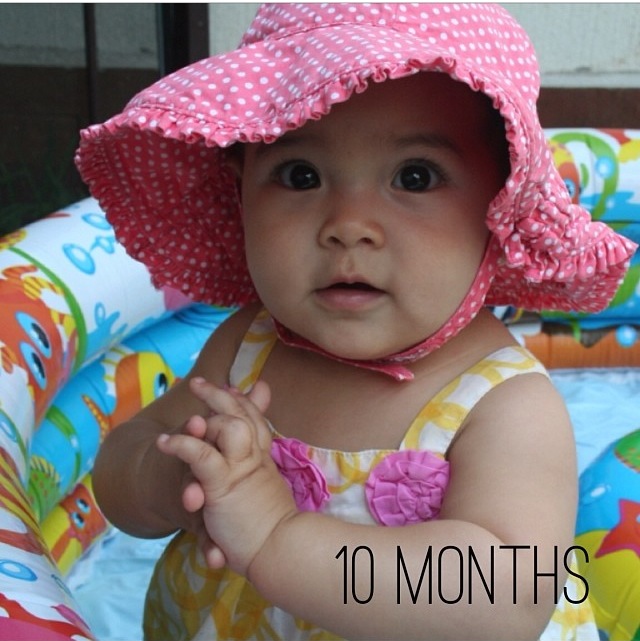
People often ask me how old you are and I keep wanting to say, oh, she’s 10 months. But the truth is, it’s June and you’re almost a year old! (ah, I can barely believe it!?) But since I am behind on these letters, in my mind you’re still just 10-months old.
At 10 months you discovered the wonderful world of pointing. And you do so with such an intensity about you. Your finger may be tiny, but your will is strong. You will keep pointing until someone takes you to what you want to see. 9 times out of 10 you are probably pointing at a water fountain, an animal, someone’s eyes or when you want me, your mama. This is all cute and fun until we are sitting tightly wedged in an airplane-window seat and you think it would be fun to point at and then poke the eyes of the poor man sitting in the middle. Sorry, kind sir.
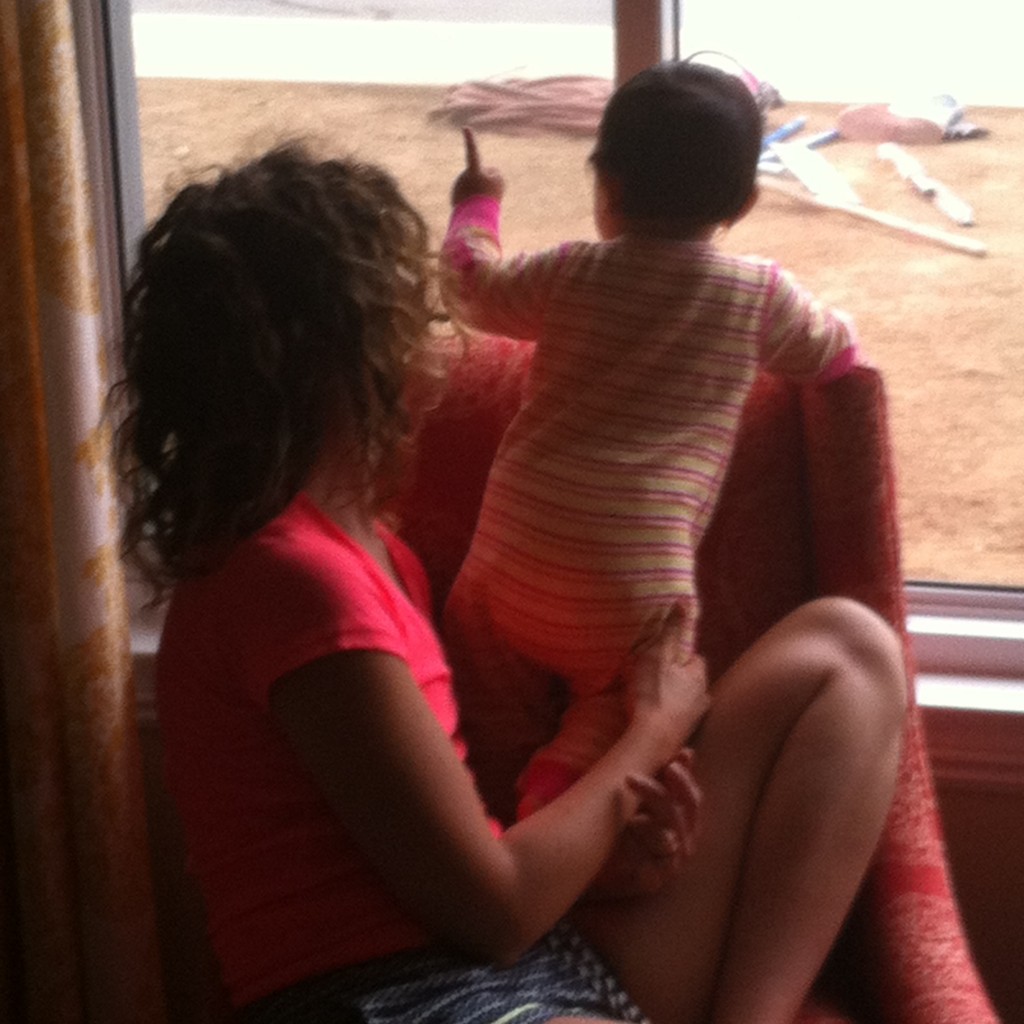
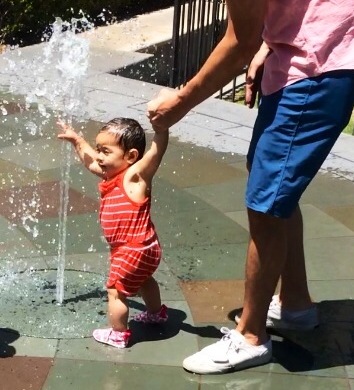
Your favorite things are playing with water, pulling books off of the shelf and laughing with Daddy. You like to eat whatever we are eating and clap along when we start singing your favorite song “los arboles se mueve.”
Elena, we spent most of your 10th month traveling. First in Ohio, then in Chicago and then in California. When I think of this trip the first 2 things I will remember are:
One, how you squealed with delight whenever we let you walk.
You’d wrinkle your little nose and grip your hands around our fingers and just GO! You walked around grass fields, and church buildings, down the cement streets of Chicago, on the sands of California beaches and maybe your favorite, on the soft carpet in people’s homes.
And two, how every night we put you to sleep on the floor.
Yep, we tried the pack n play, but you preferred the floor. So there we put you, right on top of the carpet, wrapped tightly in the Guatemalan cargador your abuela gave me before you were born. We placed some pillows all around to make you feel cosy and left the baby monitor nearby to hear when you woke up. Somehow I am sure the SID police would not approve, but hey, it worked.
But there is something else I became astutely aware of on this trip. As your mama, I spend lots of time thinking about the kind of world that you’re growing up in and in your case, the two worlds you are a part of. The Guatemalan world where we live and do life, and the US world that we visit and buy things from. I realize your Daddy and I probably will feel this tension more than you, because for us it’s new. We’re trying to navigate two worlds and two cultures and although we do it just fine most days, without giving it much thought. I know deep down, it’s like the static of an old radio. It’s always there. Quietly humming in the background. And some days it feels louder than others. The awareness that how you’re growing up is so different from how both your Daddy and I grew up.
And often I wonder, what will feel normal to you?
Elena, you’re growing up with more pairs of shoes than your Daddy ever had. And you’re barely even walking. Your Daddy had one pair of shoes for the whole year and those were for school. So when he came home from school he had to take off his black leather shoes and walk barefoot around the dirt floor. And your Daddy’s family didn’t have hot water, or even running water like we do. So the fact that I give you a warm bath every night before bed is still such a foreign idea to him. And he’s probably right, most little kids in the world don’t get a warm tub of water to bathe in every night.
But I did growing up.
Nana gave me and my sisters and brother a bath almost every night. So it seems totally normal for me. Growing up it was normal to run outside on the grass barefoot because we wanted to. And when we had to put on shoes, we had a whole closet to choose from. It was normal to have lots of choices about everything: from toys to ice cream flavors to which backpack color we wanted for each new school year. But when your Daddy was little he didn’t get to choose his backpack color each year. When your Daddy was just starting school, his older brother was going to jr high school and your Daddy remembers how his brother gave him his old backpack. It had a hole in the bottom and a broken zipper and your Daddy had to sew it so it would work. And he told me that even then, he could only open it half way or everything would fall out. There was no choice about it, it was just all he had.
One of the biggest challenges your Daddy and I have faced is deciding how we want to raise you because you see, we grew up so differently. Usually he wants to give you nice, brand new things. Things that he didn’t have growing up. And I want to get you borrowed toys or gently used hand-me-downs because I want to be resourceful and thrifty. This is part of the two worlds where you come from. Two very different socio-economic worlds. Socio-economic is a fancy word that adults like to use when talking about money. So instead of saying rich and poor, we say different socio-economic levels.
Will you appreciate running water and hot water at that? Will you know what a dishwasher and a garbage disposal are? Will you feel comfortable walking the aisles of Target one week and then walking to the tienda the next?
Mija, to be honest sometimes I wonder, will you feel more comfortable with the luxuries of the rich or the simplicity of the poor? Maybe both? or maybe neither? These are questions I ask myself.
As I write this, I realize many things that I have had to learn about life in Guatemala, will just be normal for you.
When we take walks in our neighborhood, I realize it will be completely normal for you to hear megaphones blaring “zeta gas, zeta gas” around town. And you will know how to wash your hands in the pila without someone having to show you. You will think it’s totally normal to see 3 or 4, or even 5 people piled on one motorcycle. You will understand the nuisances of viniera, vine and vengo better than I ever will and you won’t ever have to ask someone to explain to you the meaning of the national anthem. You will just get it. Because you are Guatemalan. And I hope you feel Guatemalan.
But I also hope you will feel American. I want you to learn the pledge of allegiance, and get excited for the 4th of July. I want you to know the joy of seeing the mailman put a letter in the mail box addressed to you and the excitement of coming home and finding a package at your doorstep. For as silly as it sounds I want you experience good customer service and be able to return something that didn’t fit. I want you to be able to check-out books from the public library and visit The Grand Canyon and Yosemite National Park. I want you to feel connected to the United States, because it my country. It’s where I come from. But it’s also your country.
I often wonder, if we live in Guatemala, will you feel American?
They say there’s a word for kids like you, kids who grow up in more than one culture or country. They call them third culture kids because they often identify with a way of life and living that is different from both of the cultures of their parents. I know this can he helpful in making sense of the blending of countries and cultures, but I don’t always love the idea because it sounds like an “other.” Like you’re not from either place, or either culture. Instead you’re from some other third culture.
But as I’ve watch you grow and observe the world around you, I realize there is something that transcends national identity. It’s your spiritual identity. And one of my hopes and prayers for you is that you would come to know Jesus, but not an American Jesus or a Guatemalan Jesus. But a Jesus who loved people, all people. A Jesus who lived simply, befriended outcasts and challenged the status quo. A Jesus who forgave people instead of wanting to get even. A Jesus who loves you, even more than I do.
Elena, that is where I want you to get your identity. First, as a child of God, a follower of Jesus. And then second, as a a blended-beautiful-bi-cultural-American-Guatemalan girl with probably a bit of third-cultureness.
Mija, it is both a wonderful and terrifying thought that this; our family’s life, will become your normal.
All my love,
Mama


ABOUT
A California girl with a Guatemalan heart, who is finding out that living life in-between can be somewhat complicated.
RECENT POSTS
| M | T | W | T | F | S | S |
|---|---|---|---|---|---|---|
| « Nov | ||||||
| 1 | 2 | 3 | ||||
| 4 | 5 | 6 | 7 | 8 | 9 | 10 |
| 11 | 12 | 13 | 14 | 15 | 16 | 17 |
| 18 | 19 | 20 | 21 | 22 | 23 | 24 |
| 25 | 26 | 27 | 28 | 29 | 30 | 31 |
why, hello.
 I am a part-time teacher, full-time question asker and often my sentences come out in spanglish. My husband says "I have a gift with words." But, I think he means that I just talk more than he does.
Recent Comments
- Caroline: Hi Michelle, I’ve been reading your blog for a while now, but this is the first time I’ve...
- Simply Complicated: 30;] back here to see Question #2 tomorrow and the rest of the 31 Questions Worth Asking for...
- Sharon Hoover: I look forward to your ponderings, Michelle! Culture and travels fascinate me.
- Rachel G: Awesome! I definitely want to read. Most of my life and most of my most important relationships are...
- Tirzah: Hindsight is definitely 20/20! I wouldn’t change my years at Westmont for anything. I learned so much...